

05 May MVR Monitoring Best Practices: An Essential Checklist for DQ File Compliance

When it comes to the U.S. Department of Transportation (DOT) compliance, what you think of as a minor slip-up can come with a big price tag. Among the most frequently cited violations? Non-recordkeeping. In 2026, penalties for non-recordkeeping violations alone can reach up to $19,246 per violation.
Don’t put your business at a massive risk. By following the best practices for MVR monitoring, you can stay ahead of compliance issues and keep your fleet on the road.
What FMCSA Actually Requires for MVR Monitoring
Before we list the best practices for motor vehicle record (MVR) monitoring, let’s first understand why it matters. According to the Federal Motor Carrier Safety Administration (FMCSA) under 49 CFR 391.25, every motor carrier must obtain an annual updated MVR for each commercial driver it employs. It should cover:
- The driver’s licensing authority where the driver held a commercial motor vehicle operator’s license.
- Certificate of violations applicable to FMCS regulations or Hazardous Materials regulations.
- A copy of the MVR required by paragraph is maintained in a Driver Qualification (DQ) file.
What is a DQ File and What Should it Contain?
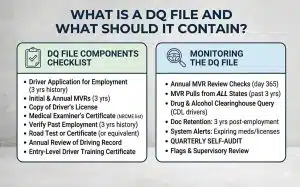
A DQ file proves that a driver is legally qualified to operate a commercial motor vehicle. As mandated by the FMCSA under 49 CFR Part 391, every motor carrier must maintain a DQ file for each driver that includes the following:
- Application for Employment

- Initial and Annual Motor Vehicle Record
- Copy of Driver’s License
- Medical Examiner’s Certificate
- Verification of Past Employment (focusing on three years history of safety performance)
- Annual Review of Driving Record
- Entry-Level Driver Training Certificate
The Real Cost of Noncompliance
The Compliance, Safety, Accountability (CSA) score is a critical measure employed by the FMCSA to evaluate the safety performance of commercial motor carriers and drivers.
Scores are calculated through FMCSA’s Safety Measurement System, with 0% being the best and 100% the worst. During a surprise DOT audit, an incomplete DQ file can be the most damaging. It can lead to a high CSA score, resulting in increased audits, higher insurance premiums, and potential contract restrictions. Under the violation code 49 CFR 391.51, a missing or incomplete DQ file alone can lead to fines costing around $810 per violation, along with vehicle shutdowns, damaged safety scores, and, in the worst-case scenario, put your company out of service.
However, enforcement isn’t always immediate. In some cases, if, after the violation, the motor carrier made a “good faith effort” to achieve DOT compliance for fleets, the compliance period may be extended by up to 60 additional days before more serious actions are enforced.
MVR Monitoring Best Practices: The Fleet Manager’s Checklist
Examining your drivers’ behavior on the road shouldn’t stop after you hire them—continuing to monitor their performance and following MVR monitoring best practices helps you catch issues early and stay ahead of compliance risks.
This practical checklist will help keep your fleet on track.

- 1) Run baseline MVR checks after hiring: Pull records for every new driver within their first 30 days.
- 2) Stay consistent with annual reviews: Set reminders or use automated monitoring tools to keep performance reviews on schedule.
- 3) Check across all states: Review MVRs from every state where a driver held a license over the past three years.
- 4) Centralize your records: Store all MVRs in a cloud-based system for easy access during audits.
- 5) Document annual driving record reviews: Save all annual reviews for every driver and make sure the reviewer officially signed them.
- 6) Complete clearinghouse queries: Run full pre-employment queries and annual limited queries for all Commercial Driver’s License (CDL) drivers.
- 7) Track medical certificates: Monitor expiration dates closely and renew as required.
- 8) Keep safety history records: Reach out to each driver’s previous employer about the driver’s accident history, document their responses, and note down those who did not reply.
- 9) Flag violations immediately: Immediately address new issues with supervisory review.
- 10) Follow retention rules: Keep DQ files for three years post-employment (five for drug and alcohol records).
- 11) Conduct an internal quarterly audit: Don’t wait for the FMCSA to find gaps; catch them early.
DQ File Self-Audit Checklist for Fleet Managers
This checklist is based on FMCSA requirements under 49 CFR Part 391. Any element showing a gap requires immediate action before an investigator arrives.
Pre-Hire File Requirements:
When hiring drivers, fleet companies must ensure that every applicant fulfills a completed Driver Application for Employment, and keep it on record file. If the applicant has prior experience as a professional driver, companies are also required by law to obtain the applicant’s MVRs from all states, for the past three years, within 30 days of hire, and request their Safety Performance History from all DOT-regulated previous employers for the past three years. Make sure that the applicant submits their road test certificate, CDL copy, and applicable endorsements.
An applicant’s driving history and skills are not the only thing fleet companies should look into. It’s also important to inquire into the drivers’ health and lifestyle by having them undergo a medical exam, obtain Medical Examiner’s Certificate on file from NRCME-listed examiner, and complete a pre-employment full Drug & Alcohol Clearinghouse query.
Ongoing Annual Requirements:
Annual MVR review checks should begin on day 365 after the hire date. It should contain all driving history and records completed and signed by the designated reviewer.
For CDL drivers, an annual Clearinghouse query is also required to obtain drug and alcohol history. In addition, a complete DOT-approved medical card or medical certificate must be updated.
Document Retention Compliance:
All files acquired from the previous employers over the past three years should be verified for accuracy. In addition, Certificates of Violations (COV) issued before May 9, 2022, must be retained for 36 months from the document date.
System and Access Checks:
An internal audit should be completed within the last 90 days to verify that all processes and records meet required standards. All files should be stored in a secure, cloud-based system with automated expiration alerts enabled for medical certificates and annual reviews to prevent lapses in compliance.
The compliance dashboard should also be regularly reviewed to identify flagged drivers.
How Fleet Response Supports MVR Compliance
At Fleet Response, we take the stress out of driver risk management. Through an automated MVR monitoring program, we help you ensure your company remains compliant without having to navigate complex requirements.

- Customizable point system: Our system accounts for each driver’s diversity, categorizing them as clear, low, medium, or high risk.
- Automatic annual MVR runs: A critical feature of our program that helps you identify new offenses while also acknowledging compliant drivers.
- 24/7 real-time access: Our fleet driver compliance program includes a VISIBILITY portal that provides instant access to relevant data, enabling you to take prompt action when needed.
- Automated notifications and reminders: Our system sends alerts to ensure you stay updated with changes in driver’s risk level, upcoming renewals, and other key updates.
Frequently Asked Questions (FAQ)
1. How often are MVR checks required by FMCSA?
FMCSA requires an MVR at the time of hire (within 30 days) and at least once every 12 months for every active commercial driver. MVRs must be pulled from every state where the driver held a license in the past three years, not just the current licensing state.
2. What documents must be in a Driver Qualification File?
A complete DQ file under 49 CFR Part 391 includes the Driver Application for Employment, Motor Vehicle Record, Medical Examiner’s Certificate, CDL copy and endorsements, Drug and Alcohol Clearinghouse queries, Safety Performance History from prior DOT-regulated employers, and the Annual Review of Driving Record. Fleet managers are responsible for assembling and maintaining each of these elements—Fleet Response provides the MVR data component.
3. What are the penalties for incomplete DQ files?
FMCSA record-keeping penalties reached $19,246 in 2026. Multiple violations per driver compound rapidly during an audit, and incomplete files can serve as evidence of systemic compliance failure in accident litigation. This makes efficient driver qualification file management essential.
4. Is the Certificate of Violations still required?
No. FMCSA eliminated the Certificate of Violations requirement as of May 9, 2022. However, annual MVR reviews and the Annual Review of Driving Record remain fully mandatory.
5. Can DQ files be stored digitally?
Yes. FMCSA allows driver qualification requirements to be stored digitally, provided they are secure, legible, and readily accessible for inspection. Digital systems also enable faster retrieval during audits, which frequently arrive with little advance notice.
Conclusion
Even when you’re following MVR monitoring best practices, manual tracking still leaves room for human error that can lead to thousands of dollars in audit penalties.
Safety compliance doesn’t have to be complicated. Investing in Fleet Response’s automated MVR monitoring system is a smart way to streamline your processes and protect your business.